If you’re walking to lose weight, the question isn’t just how many steps did I take?
It’s how do I actually know I’m making progress?
I’ve worked with beginners who hit 8,000 or even 10,000 steps daily but still feel stuck. The problem usually isn’t effort. It’s tracking the wrong things.
Learning how to track walking progress for weight loss goes beyond counting steps. It means understanding pace, active minutes, calorie burn, and how your body responds over time. When you track the right metrics, you stop guessing and start improving.
Two people can walk the same number of steps and burn completely different amounts of calories. One strolls casually. The other walks briskly for 40 focused minutes. Same steps. Very different results.
That’s why in this guide, I’ll show you:
- What to measure besides steps
- How to use a walking tracker effectively
- How often to review your data
- And how to adjust when progress slows
When you track walking progress the right way, you turn a simple habit into a structured fat loss strategy.
The Right Way to Track Walking Progress for Weight Loss
When people tell me they’re walking to lose weight, they almost always mention one number first:
“I hit 10,000 steps.”
That’s great. But that number alone doesn’t tell me much about fat loss progress.
If you truly want to understand how to track walking progress for weight loss, you have to look beyond movement and start measuring effort.
Walking progress isn’t just about how far you go. It’s about how hard you work, how consistently you show up, and whether your body is adapting over time.
Let me break down how I approach this with beginners.
Step 1: Stop Tracking Steps Alone and Start Tracking Effort
Steps are your baseline. They tell you that you moved.
But they don’t tell you how much energy you used.
Two people can both hit 9,000 steps:
- One spreads them slowly throughout the day.
- The other walks briskly for 40 focused minutes.
The second person burns significantly more calories because intensity drives calorie burn.
Before increasing your step goal, ask yourself:
Did I spend at least 30 minutes walking at a slightly challenging pace?
If not, that’s where I’d start.
Quality first. Then quantity.
Step 2: Establish a One-Week Baseline Before Changing Anything
This is where most beginners rush.
They immediately increase steps or pace without knowing their starting point.
Instead, spend one full week just observing.
Track:
- Average daily steps
- Usual walking pace
- Weekly active minutes
- Estimated calorie burn
- Do not try to improve yet. Just collect data.
This baseline becomes your reference point. Without it, you can’t measure improvement.
If you’re unsure how walking fits into your broader routine, revisit workout frequency for beginners so you don’t overtrain early.
Do You Need the Best Fitness Tracking App?
I get asked this a lot.
“Do I need the best fitness tracking app to see results?”
Honestly, no.
You don’t need the most advanced device or a paid subscription.
You need something:
- Easy to use
- Clear to read
- Consistent
Some people use smartwatches. Others use free mobile apps. Some track with their phone alone.
Others choose one of the best fitness tracking apps and connect it to their phone and smartwatch.
Step 3: Improve Intensity Before Increasing Time
When progress feels slow, most people add more minutes.
But I usually adjust intensity first.
Instead of walking longer at the same relaxed pace, try:
- Walking 30 minutes slightly faster
- Adding intervals (1 minute brisk, 2 minutes moderate)
- Including mild inclines
If you’re ready to increase the difficulty safely, reviewing the benefits of incline walking can help raise calorie burn without excessive joint stress.
Small intensity upgrades often outperform adding 20 random extra minutes.
Step 4: Review Weekly Trends, Not Daily Fluctuations
Daily numbers bounce around. And that’s normal.
One day, you burn 320 calories. The next day, 240. That doesn’t mean you failed.
I focus on weekly averages. Every week, I review:
- Average daily calorie burn
- Total active minutes
- Average pace
Patterns matter more than single days.
That’s Why I Recommend Pairing Your Tracker With a Workout Journal
Your tracker shows numbers. But it doesn’t show how you felt.
This is where a workout journal becomes powerful.
In your journal, you can record:
- Energy levels
- Sleep quality
- Mood
- Effort level
- Muscle soreness
Sometimes progress slows not because you need more steps, but because you’re tired, stressed, or under-recovered.
Your walking data, plus a workout journal, gives you context.
Numbers tell you what happened. Reflection tells you why.
That combination improves decision-making long term.
Step 5: Adjust When Your Body Adapts
Here’s something most beginners don’t expect:
Your body gets more efficient.
If you walk the same pace and distance for weeks, you burn fewer calories doing the same activity.
That’s adaptation.
When progress slows, I make one small change:
- Add 5 to 10 brisk minutes
- Increase pace slightly
- Add one longer weekend walk
- Include 1 interval session weekly
Sometimes, adding one lighter active recovery day actually improves long-term consistency.
Small, strategic adjustments keep fat loss moving without extreme changes.
Step 6: Track Fitness Improvements, Not Just Weight
If you only watch the scale, you’ll miss progress.
I always ask beginners:
- Is my pace improving?
- Is my heart rate lower at the same speed?
- Do I feel less breathless?
Those are real signs of progress.
Walking is not just about burning calories. It improves cardiovascular fitness. And improved fitness makes fat loss easier over time.
If you’re combining walking with strength training, following a structured workout plan for weight loss will amplify results.
Which Metrics Actually Matter Most When Tracking Walking Progress?
Once you understand the steps, the next question becomes: What numbers should I actually care about?
When people learn how to track walking progress for weight loss, they often feel overwhelmed by all the data their tracker shows. Calories. Pace. Heart rate. Active minutes. Elevation. Distance.
Not all of those matter equally.
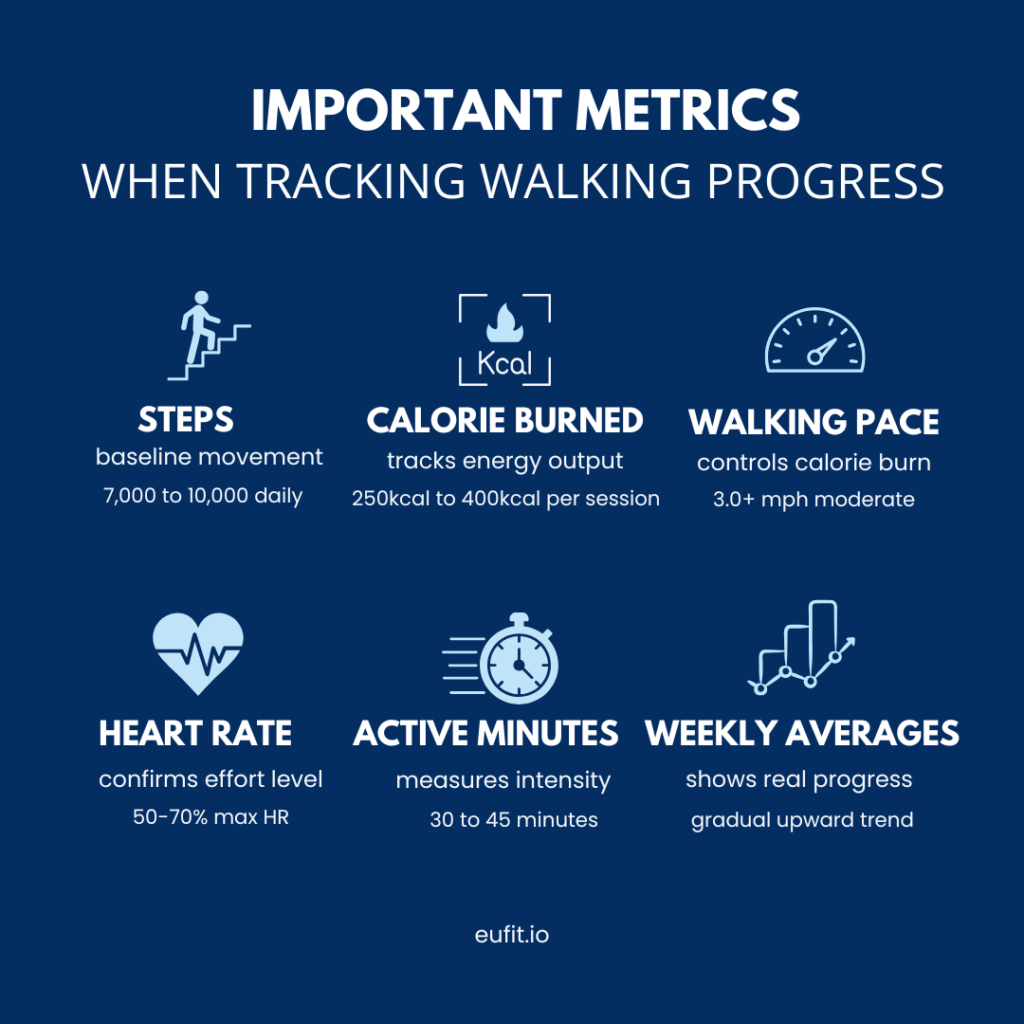
Here are the metrics I personally prioritize when reviewing walking data.
1. Calories Burned
Let’s start with the obvious one.
Calorie burn is never perfectly accurate. Wrist trackers estimate based on movement and heart rate. They can be off by a small margin.
But here’s what matters:
Consistency in trends.
If your weekly average calorie burn increases over time, that means you’re increasing output.
For beginners, I typically aim for:
250 to 400 calories per focused walking session.
Over five days, that adds up.
What I don’t do is obsess over whether today was 312 or 327 calories.
Patterns beat precision.
2. Walking Pace
This is one of the most underrated fat loss metrics.
Pace tells you how efficiently you’re working.
General guide:
- 2.0 to 2.5 mph — light, casual
- 3.0 to 3.5 mph — moderate
- 4.0+ mph — brisk
A faster pace increases heart rate and energy demand.
If two people walk the same number of steps but one walks at 3.5 mph and the other at 2.3 mph, the calorie difference can be significant.
When I want to increase fat loss without adding time, I look at pace first.
3. Active Minutes
Active minutes measure how long you stay at moderate or higher intensity.
This is where real training happens.
If your tracker shows 9,000 steps but only 12 active minutes, that tells me most of your movement was light and spread out.
I typically recommend:
30 to 45 active minutes per day for beginners.
This aligns with general health guidelines for moderate physical activity.
Walking at moderate intensity improves heart and lung function, which supports long-term fat loss.
4. Heart Rate Zones
If your tracker measures heart rate, this becomes powerful.
Moderate intensity is typically around 50 to 70 percent of your estimated max heart rate.
That’s where:
Cardiovascular fitness improves
Calorie burn increases
Fat oxidation becomes more efficient
Over time, if your heart rate drops at the same walking speed, that means you’re getting fitter.
Fitness improvement often shows up before visible fat loss.
5. Weekly Averages
This might be the most important one.
Daily fluctuations mean nothing in isolation.
Look at:
- Weekly average pace
- Weekly active minutes
- Weekly calorie burn
If those numbers slowly rise over several weeks, you are progressing.
That’s how to track walking progress properly: based on patterns.
A Quick Reality Check About 10,000 Steps
Many people believe 10,000 steps is mandatory for weight loss. It’s not.
Research shows that even 4,000 to 8,000 steps daily can provide health benefits, especially when combined with moderate intensity.
The goal is not to hit a number; it should be a sustainable effort and gradual progression.
When Can You Expect to See Real Progress?
One of the biggest reasons people quit walking for weight loss isn’t lack of effort.
It’s unrealistic expectations.
When I teach someone how to track walking progress for weight loss, I always explain this first:
Progress shows up in stages.
Weeks 1–2: Internal Changes
During the first two weeks, you might not see much on the scale.
But you’ll likely notice:
- Less breathlessness during walks
- Slight improvements in pace
- Better daily energy
- Reduced soreness
This is your body adapting.
Your cardiovascular system is getting stronger, your muscles are becoming more efficient, and your walking form improves naturally.
Your tracker may show:
- Slightly higher active minutes
- A steadier pace
- Lower heart rate at the same speed
Those are real signs of progress, even if the mirror hasn’t changed yet.
Weeks 3–4: Measurable Trends
Around week three or four, consistent walkers often begin to see measurable changes.
This might include:
- 0.5 to 1 pound per week of weight loss
- Clothes fitting differently
- Improved endurance
- Faster recovery between walks
This is when your weekly averages start telling a clear story.
If your calorie burn and active minutes have increased steadily, and your nutrition supports a moderate deficit, fat loss usually follows.
If you’re unsure how many calories walking actually burns at your weight, reviewing how many calories walking burns can give you more context.
Weeks 5 and Beyond: Compounding Results
This is where walking becomes powerful.
By week five and beyond, something important happens:
Walking feels easier.
Your body has adapted, your stamina has improved, and your pace may be higher without feeling harder.
This is when small upgrades create noticeable change.
You can:
- Add incline
- Extend brisk intervals
- Increase total active minutes slightly
If you combine walking with strength training using a structured workout plan for weight loss, fat loss becomes even more sustainable.
A Realistic Fat Loss Expectation
Sustainable fat loss averages:
0.5 to 1 pound per week.
Faster loss is possible, but often harder to maintain. Walking works best when it’s consistent and progressive.
What Progress Really Looks Like
I always remind beginners that progress is not just a lower number on the scale.
It’s:
- Walking faster at the same heart rate
- Reaching 40 active minutes without feeling drained
- Recovering faster the next day
- Feeling stronger during daily activities
Your walking tracker doesn’t just measure steps.
It measures habit strength, discipline, and adaptation. And adaptation is what creates lasting fat loss.
Conclusion: Turning Walking Into a Measurable Fat Loss Strategy
Walking can absolutely support weight loss. But random walking rarely delivers consistent results. When you learn how to track walking progress for weight loss, you stop guessing and start adjusting intelligently.
You:
- Establish a baseline.
- Improve intensity before increasing time.
- Review weekly trends instead of obsessing over daily fluctuations.
- Adjust when your body adapts.
That’s how walking shifts from “just being active” to becoming a structured fat loss tool.
You don’t need:
- the most advanced device.
- extreme step goals.
- need perfection.
You need awareness, consistency, and small upgrades over time.
Track effort, not just steps.
Focus on trends, not single days.
Improve gradually, not dramatically.
That’s how walking becomes sustainable.
And sustainability is what creates lasting results.
Frequently Asked Questions (FAQs)
Commonly asked questions about how to track walking progress, especially for beginners.